
You finish a workout, sit down to catch your breath, and feel it again, that burning sensation below shoulder blade that refuses to calm down.
It might show up during heavy presses, after long days at a desk, or halfway through a run, and it leaves you wondering if you should keep training or shut it down.
You are not weak, broken, or simply getting old.
You are an active person with a busy life and a body that is sending you some very specific information.
At RecoverRx Physical Therapy, we see active adults and athletes deal with this exact issue all the time. The good news is that burning under the shoulder blade is often fixable when you understand what is driving it and how your movement patterns play a role.
In this blog, you walk through what is actually in that area, what typically causes the burning, and how to tell if it is muscle, joint, or nerve related.
You also see practical, movement-based strategies to calm things down, keep training smarter, and know when it is time to bring in a sports physical therapist for help.
Understanding That Burning Sensation Below Your Shoulder Blade
When you feel a burning sensation under your shoulder blade, it can be sharp, nagging, or hot and achy.
To make sense of it, you first need to know what actually lives in that area and how it works during your sport or training.
What Is Actually Under Your Shoulder Blade
Your shoulder blade, or scapula, sits on your rib cage like a sliding platform. It moves every time you reach, press, pull, throw, or swing.
Under and around your shoulder blade, you find a busy neighborhood of structures, including:
- The scapula itself
- The ribs and thoracic spine, which are your mid back
- Muscles like the rhomboids, middle, and lower traps
- The serratus anterior along your ribs
- Rotator cuff muscles that help control the shoulder
- Nerves that travel from your neck down into your arm
When you lift, run, swim, swing a racquet, or do push-ups, all of these parts coordinate.
If one area moves poorly or works too hard, the area under your shoulder blade often pays the price.
Common Athletic Causes Of A Burning Sensation Below Your Shoulder Blade
That burning usually does not come out of nowhere.
For active adults and athletes, it often traces back to training habits and daily life.
Some of the most common triggers include:
- Sudden jumps in training volume or intensity
- Heavy pressing or overhead work without enough pulling and mid-back strength
- Technique errors in lifts like bench press, push press, pull-ups, or barbell rows
- Repetitive overhead motions in sports like tennis, baseball, volleyball, or swimming
- Long hours at a desk, laptop, or in the car, followed by intense workouts
Your body can usually tolerate one or two of these factors.
The problem shows up when you stack them together, and your tissues never get a chance to recover or adapt.

Conditions That Can Create A Burning Feel In This Area
Burning is a symptom, not a diagnosis.
Different problems can create a similar sensation in that same spot.
Some of the more common movement and tissue issues include:
- Myofascial trigger points in the rhomboids, traps, or spinal muscles
- Joint irritation or stiffness in the thoracic spine
- Scapular dyskinesis, which means your shoulder blade does not move smoothly
- Overworked muscles that try to stabilize when other muscles are underperforming
- Nerve irritation that sends a hot or electric feel into the mid-back
Trigger points often feel like a small, tender knot that burns when you press on it or use the muscle. Joint irritation tends to feel deeper and can flare with twisting, arching, or slouching.
Nerve-related burning can feel sharper, more electrical, or may travel into the shoulder, arm, or chest.
That does not always mean a serious problem, but it does mean you should pay attention and not just push through.
How To Tell If It Is Muscle, Joint, Or Nerve
You do not need an advanced degree to start figuring out what might be involved.
Simple checks give you valuable clues.
Notice how the area behaves when you:
- Move your shoulder, neck, or upper back through different directions
- Load the area with rows, presses, or carries
- Sit or stand with tall, stacked posture
- Take a deep breath and expand your ribs
Muscle-related burning often:
- Increases when you use that muscle directly
- Feels better after gentle movement or light activity
- Improves with local pressure or soft tissue work
Joint-related burning often:
- Feels deeper and more stuck
- Flares with twisting or extending the mid back
- May improve with specific mobility work or joint opening postures
Nerve-related burning often:
- Radiates or zings into other areas
- Comes with numbness, tingling, or clear weakness
- Changes with neck position or nerve tension tests, not just local movement
These patterns do not replace a full assessment, but they help you understand that not all burning under the shoulder blade is the same.
That understanding keeps you from chasing the wrong fix.
When Athletes Should Actually Worry
Most of the time, this type of burning is frustrating, not dangerous. Still, you should know when it crosses the line from annoying to pay attention now.
Call your doctor or urgent care right away if you notice:
- Chest pain with pressure, tightness, or spreading into your jaw or left arm
- Shortness of breath that feels new or intense
- Sudden sweating, nausea, or feeling faint
- Fever, chills, or unexplained weight loss
- Recent trauma like a fall, crash, or hard hit followed by severe pain
These signs can point to heart, lung, infection, or serious structural issues.
Do not try to stretch or breathe your way through those symptoms.
You should reach out to a sports physical therapist or medical provider soon if you notice:
- Burning that keeps returning for more than two to four weeks
- Pain that wakes you up at night or affects your sleep position
- Increasing weakness, dropping things, or losing shoulder motion
- Pain every time you ramp up training or return to certain lifts
Those are signs that the problem sits deeper than a simple muscle knot and that your movement system needs a closer look.
If that burning spot under your shoulder blade keeps nagging your workouts, you do not have to keep guessing.
A short conversation can help you see your next best step.
RecoverRx Physical Therapy offers a free 15-minute discovery call with our team so you can share what you feel, learn how we can help, and decide if we are a good fit for your goals.
To schedule, call RecoverRx PT at 331 253 2426 and take the next step toward training without that constant burn in your back.
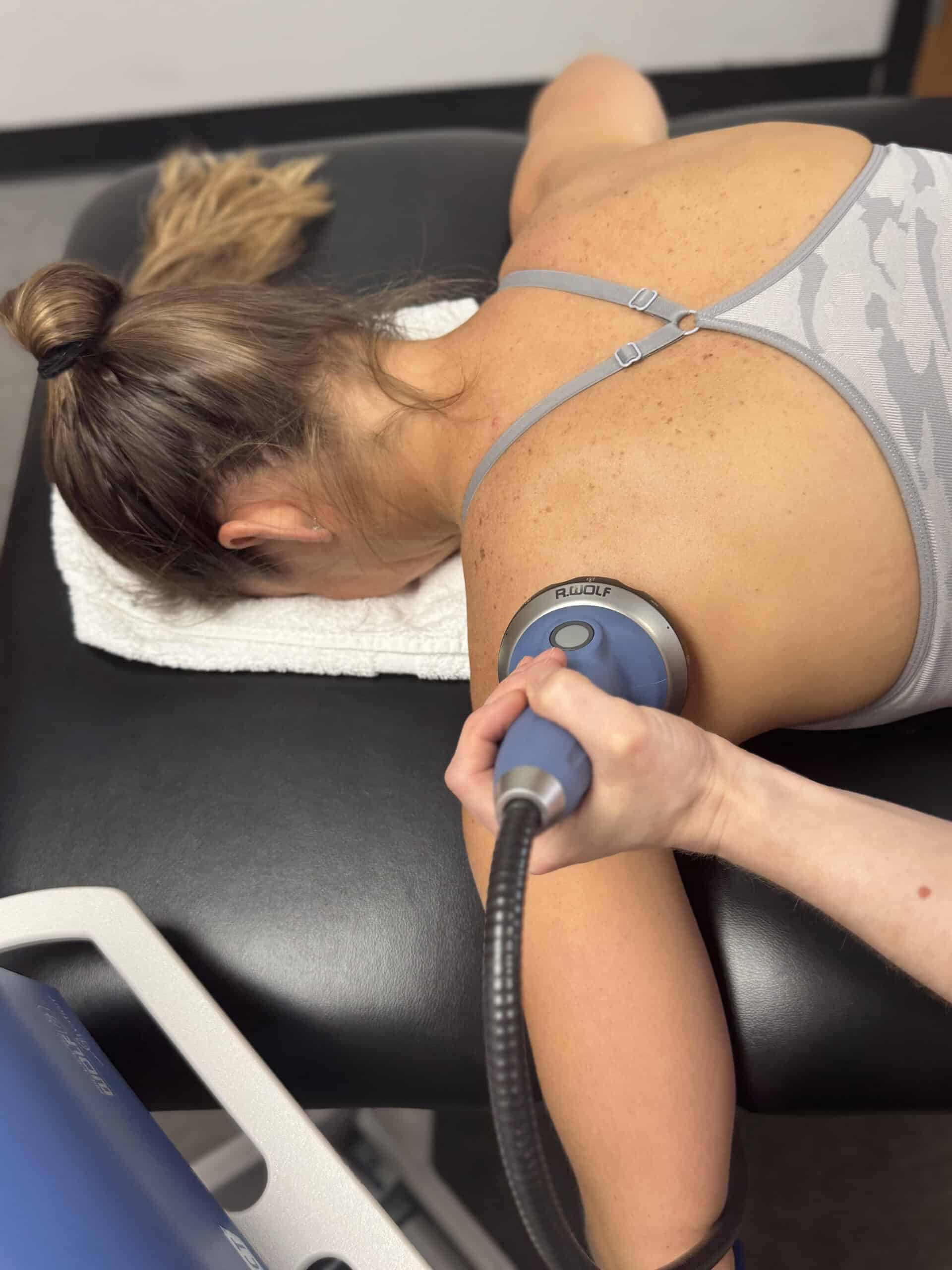
Movement-Based Fixes For A Burning Sensation Below Your Shoulder Blade
Once you rule out serious issues, it is time to focus on what you can control. Movement often plays the biggest role in both the cause and the solution.
You want a plan that calms symptoms, restores motion, and then builds strength and control.
If you only chase short-term relief, the burning usually returns the next time your training spikes.
Short Term Relief That Does Not Derail Your Training
You do not always need to stop training completely. You usually need to train smarter and let irritated tissues settle while you keep the rest of your body strong.
Helpful short-term strategies include:
- Reducing pressing or overhead loads for a short period
- Swapping barbell lifts for dumbbells or landmine variations
- Staying in pain-free or low-pain ranges while symptoms calm down
- Shortening workouts slightly without fully stopping them
Positions that often help calm things down include:
- Lying on your back with a small rolled towel under your mid-back
- Supported child pose with your hands on a bench or couch
- Gentle reach and breathe positions that let your ribs expand
Soft tissue work, like foam rolling or massage guns, can give temporary relief. Use them as a bridge to better movement, not the whole plan.
Mobility Work To Free Up The Thoracic Spine And Shoulder Blade
If your mid back and ribs move like a brick, your shoulder blade has to cheat. Over time, those cheats show up as burning, pinching, or pulling.
You can start with simple mobility drills such as:
- Open book rotations while lying on your side
- Child pose with a reach to each side to target the ribs
- Gentle thoracic extension over a foam roller or rolled towel
Focus on smooth, comfortable motion, not forcing a big crack or stretch. You want your ribs and thoracic spine to share the load when you rotate, press, or pull.
Breathing matters here, too.
When you take slow, deep breaths into your sides and back, you help your ribs move and reduce tension in the muscles under your shoulder blade.
Activation Drills For The Muscles Behind The Shoulder Blade
Many athletes have strong lats and upper traps but sleepy mid-back muscles. When those stabilizers check out, other tissues grip and burn.
You can wake up the right muscles with focused activation drills like:
- Scapular retractions with a band, keeping your shoulders away from your ears
- Prone Y, T, and W raises on a bench or floor with light weight
- Wall slides where you gently reach up and feel your shoulder blades glide
- Serratus work such as wall plus pushes or bear plank plus variations
The goal is not to crush these drills with heavy loads. The goal is to feel the right areas working while the neck and upper traps relax a bit.
Think about quality before quantity.
Two sets of great reps help more than five sets of sloppy ones that only reinforce bad patterns.
Building Durable Strength For Active Adults And Athletes
Once the area calms and the right muscles wake up, you want to build strength that holds up under real training. This is where you transition from fixing pain to creating durability.
Great strength choices include:
- Single arm rows that let you control your shoulder blade pull
- Chest-supported rows to load your mid back without stressing the low back
- Face pulls that train the rear delts and mid traps
- Landmine or half-kneeling presses that keep your ribs and scapula stable
You can think about strength in three phases.
Start with light loads and controlled tempo, then add more volume and moderate load once motion feels good, and finally progress to heavier and more dynamic work that matches your sport.
Keep a balance between pushing and pulling in your weekly plan. If you push twice as often as you pull, that burning spot often reminds you.
Technique And Lifestyle Tweaks That Make The Biggest Difference
You can do all the exercises in the world and still feel stuck if you do not clean up your technique and daily habits.
The way you move in your sport and at your desk matters.
Common lifting habits that stress the area include:
- Shrugging your shoulders up on every rep
- Flaring your ribs forward when you press or row
- Letting the bar or dumbbell pull your shoulders forward at the bottom of a lift
Sport-specific patterns that often show up include:
- Runners with rounded upper backs and arms that swing across the body
- Racquet and throwing athletes who rely on arm speed more than trunk rotation
- CrossFit and strength athletes who hammer pressing but skip mid-back work
Daily life can feed the problem too. Long hours slumped over a laptop can shorten the front of your chest and put constant tension between your shoulder blades.
Helpful tweaks include:
- Adjusting your screen so your eyes meet the top third of the monitor
- Keeping your feet flat and your hips slightly higher than your knees
- Taking short movement breaks every 45 to 60 minutes
- Doing a few quick mid-back or shoulder blade drills during those breaks
These small changes reduce the baseline stress on your system so your training no longer layers on top of a tired, cranky foundation.

When It Is Time To See A Sports Physical Therapist
If you apply these ideas and the burning still lingers, it does not mean you failed. It usually means the problem has more layers than a simple home program can address.
Signs you may benefit from a movement-based assessment include:
- The burning always returns when you hit certain weights or distances
- You feel uncertain or guarded every time you press, serve, or throw
- You notice compensations like twisting, shifting, or holding your breath during lifts
- You have a history of shoulder, neck, or mid-back issues on the same side
A good sports physical therapist looks at how your whole system works, not just the painful square inch under your shoulder blade.
That level of detail helps you move with confidence again instead of worrying about every rep.
How Physical Therapy Helps You Move Past That Burning Pain
You do not have to accept a constant burning sensation below your shoulder blade as the price of staying active. With the right plan, you can calm the pain, fix the root cause, and get back to training with confidence.
Getting To The Root Cause, Not Just Numbing The Burn
Quick fixes can feel nice in the moment, but they rarely solve why the area flares in the first place. We look at how you move, load, and recover so you can address the real driver of your symptoms.
At RecoverRx Physical Therapy, we focus on clear explanations, movement testing, and goal-driven plans. You know exactly what is going on and what each step of your rehab is working on.
One On One, Performance Focused Care For Active Adults And Athletes
If you live in the Chicago western suburbs and train hard, you deserve care that respects your goals. We build your plan around your sport, schedule, and performance targets.
Sessions at RecoverRx stay truly one-on-one from start to finish, so your time never gets split between multiple patients.
That attention lets us fine-tune your program and progress you safely without backing off more than you need.
What Working With RecoverRx Physical Therapy Can Look Like
Your path does not have to be complicated, but it should be personal. We help you move through a simple, logical progression that fits your life as an active adult or athlete.
A typical process might include:
- Early sessions that calm the burning, restore motion, and dial in the diagnosis
- A focused phase that builds strength, control, and sport-specific technique
- A return to sport plan that tests your shoulder, spine, and confidence under real-world demands
Throughout this process, the goal is to build long-term movement confidence, not just short-term relief. You leave with tools to handle future flare-ups and protect your training.
Ready To Stop The Burning And Get Back To Confident Training
If that burning spot under your shoulder blade keeps nagging your workouts, you do not have to keep guessing.
A short conversation can help you see your next best step.
RecoverRx Physical Therapy offers a free 15-minute discovery call with our team so you can share what you feel, learn how we can help, and decide if we are a good fit for your goals.
To schedule, call RecoverRx PT at 331 253 2426 and take the next step toward training without that constant burn in your back.