Shoulder internal rotation affects your ability to reach behind your back, put on a jacket, lift weights, and perform everyday movements without pain. Limited shoulder internal rotation is often caused by stiffness, muscle imbalance, past injuries, or poor joint control.
If your shoulder feels stuck, weak, or uncomfortable during movement, the problem may not be the shoulder alone. A physical therapy evaluation can identify what is limiting your range of motion and help restore strength, mobility, and confidence.
Key Takeaways
- Limited shoulder internal rotation can affect daily activities, workouts, and sports performance.
- Common causes include tight posterior shoulder muscles, joint stiffness, injuries, and poor movement patterns.
- Restoring mobility requires more than stretching, it also requires strength and control.
- Rotator cuff and scapular stability play an important role in healthy shoulder movement.
- Physical therapy can help improve shoulder range of motion and reduce pain through personalized treatment.

Shoulder Pain and Range of Motion: How They Are Connected and How to Find Relief
Shoulder pain rarely shows up without a reason. In many cases, limited shoulder range of motion is both the cause and result of deeper dysfunction in the joint. Whether you’re an athlete or just trying to stay active in the western suburbs of Chicago, we need to understand what’s going wrong before we can make it right.
Why Shoulder Range of Motion Matters
Every time we reach overhead, lift weights, or throw a ball, we rely on the shoulder’s full range of motion. When motion becomes limited, pain often follows, especially during sports, training, or daily movement.
We often see restrictions in:
- Internal shoulder rotation
- External rotation
- Overhead shoulder abduction
- Functional movement during warmups or workouts
These restrictions affect performance, recovery, and even how we sleep. By restoring full shoulder range, we protect the rotator cuff muscles, improve strength, and reduce the risk of long-term injury.

What’s Really Going On Inside the Shoulder?
The glenohumeral joint is highly mobile and relies on dynamic stability. When the rotator cuff, deltoid muscle, or scapular stabilizers are weak or imbalanced, pain develops quickly.
We often find issues with:
- The glenohumeral joint capsule becoming tight
- Posterior shoulder stiffness limiting internal rotation
- Subacromial bursitis or rotator cuff tendonitis
- Anterior dislocation from poor glenohumeral joint stability
- Chronic overuse injuries in the subscapularis muscle or biceps tendon
We also assess structures like the coracohumeral ligament, acromioclavicular joint, sternoclavicular joint, and coracoacromial arch. When even one part of this system breaks down, shoulder pain and restricted motion follow.
How Sports Physical Therapy Helps You Find Relief
We don’t start with surgery. We start by identifying the cause of your shoulder limitation and then build a plan that restores normal joint mechanics. For overhead athletes and active adults, physical therapy is often all you need.
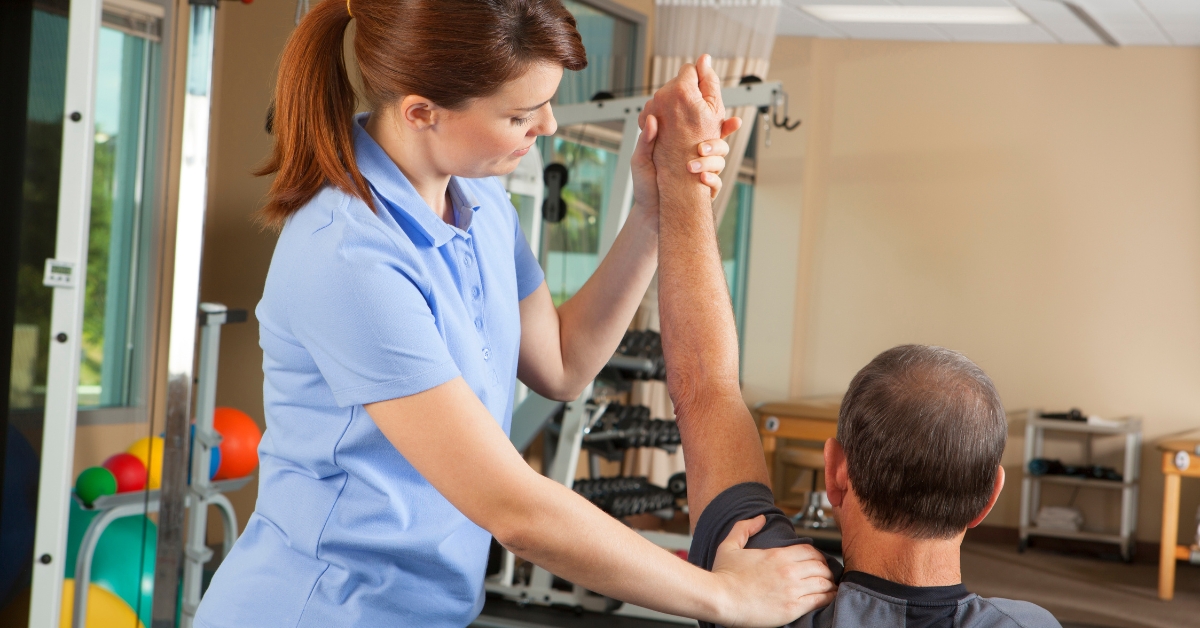
- Manual therapy to increase passive range and joint mobility
We use hands-on techniques to improve movement in the glenohumeral joint capsule and surrounding tissues. This helps release restrictions that limit internal rotation, shoulder abduction, and external rotation. - Targeted exercises for scapular retraction and rotator cuff strength
We guide you through movements that retrain how the scapula glides and stabilizes. These exercises also activate muscles like the infraspinatus, supraspinatus, and teres minor to reinforce shoulder joint control and improve load tolerance. - Subscapularis activation drills to restore internal shoulder rotation
We focus on restoring the strength and function of the subscapularis muscle, which facilitates internal rotation and contributes to glenohumeral joint stability. You’ll learn how to engage this muscle properly during pressing, pulling, and functional motions. - Neuromuscular re-education for humeral head control
We use cues and resistance-based drills to improve how your shoulder responds to motion. These strategies help center the humeral head in the glenoid socket, even under stress or during high-speed activity. - Corrective movement training to reduce stress across the glenohumeral joint
We identify dysfunctional movement patterns contributing to your pain. Through repetition, posture correction, and motor control strategies, we teach you to move with proper alignment so your shoulder works efficiently and pain-free.
We also look at the whole body. Shoulder pain can be driven by poor core control, tight hips, or altered rotation through the spine. That’s why we take a full-body approach, especially with throwing athletes or anyone doing repetitive overhead activities.
When to Look Deeper
If you’re not seeing progress, more complex conditions may be involved. These could include:
- Glenohumeral internal rotation deficit
- Adhesive capsulitis
- Rotator cuff tears involving the subscapularis tendon or teres minor
- Glenoid labrum tears from high-velocity throwing
- Injury to the rotator interval or inferior aspect of the capsule
In these cases, we use special tests like the sulcus sign or assess for glenohumeral instability.
Let’s Get You Moving Again
Whether you’re training for the Shamrock Shuffle, playing in a summer softball league, or just trying to lift pain-free again, shoulder pain shouldn’t hold you back.
At RecoverRx Physical Therapy, we take shoulder pain seriously. Whether you’re dealing with a stiff shoulder, chronic discomfort, or a recent injury, we guide you through a full recovery process focused on movement, function, and long-term relief.
We listen closely, test thoroughly, and build a recovery strategy that fits your body and your goals. Let’s work together to restore shoulder range of motion, strengthen your movement patterns, and help you live without pain.
We Start by Identifying What’s Holding You Back
We don’t just look at your shoulder. We assess how your entire body moves so we can find what’s limiting your range and what needs immediate attention.
During your first visit, we complete a thorough physical examination. We test your:
- Shoulder range of motion in all directions
- Internal rotation and external rotation under load and in isolation
- Position of the humeral head within the glenohumeral joint
- Rotator cuff strength and activation patterns
- Scapular retraction, stability, and mobility
- Passive and active mobility in functional movements
If we see signs of glenohumeral joint instability, subscapularis tendon restrictions, or capsular tightness, we create a plan right away to address it.
We Build a Recovery Plan Designed Just for You
Our three-phase system walks you through recovery, strength, and performance. We don’t just want your shoulder to stop hurting. We want you to trust it again.
Your plan often includes:
- Manual therapy for the glenohumeral joint capsule and surrounding soft tissues
- Exercises to activate and strengthen the subscapularis muscle and the rest of the rotator cuff
- Mobility work to address internal shoulder rotation and restore full range
- Functional training based on the activities or sports you care about
- Neuromuscular re-education for dynamic stability during overhead activities
Every step of the way, we explain what we’re doing and why. You’ll understand your pain, your movement patterns, and what we need to do to move forward.

We Stay With You Until You’re Fully Ready
Shoulder stiffness doesn’t go away overnight. But with consistent care and progressive loading, your joint regains strength, confidence, and control.
As your range improves, we challenge your:
- Strength in positions of vulnerability
- Scapular control during dynamic movement
- Coordination of upper arm, elbow, and trunk for real-life carryover
You finish strong and know how to maintain the results. Our goal is to help you live pain-free and stay active long after your time in the clinic ends.
Let’s Get Started Together
You don’t have to guess your way through shoulder pain. We’re here to walk with you through each step of your recovery.
Speak with a PT, set up a Discovery Visit, or call us at 331-253-2426 to book your first appointment today. Let’s restore your shoulder range of motion and get you back to doing what you love.
Shoulder Internal Rotation FAQs
What Causes Limited Shoulder Internal Rotation?
Limited shoulder internal rotation can happen because of tight shoulder muscles, joint stiffness, previous injuries, rotator cuff problems, or poor movement patterns. A physical therapist can identify the specific cause.
How Do You Improve Shoulder Internal Rotation?
You can improve shoulder internal rotation through mobility exercises, strengthening the rotator cuff, improving scapular control, and addressing movement restrictions that limit shoulder function.
What Muscles Are Responsible For Shoulder Internal Rotation?
The main muscles involved in shoulder internal rotation include the subscapularis, pectoralis major, latissimus dorsi, and anterior deltoid. These muscles help control shoulder movement and stability.
Why Can’t I Rotate My Shoulder Internally?
Difficulty rotating your shoulder inward may come from stiffness, pain, weakness, or changes in how the shoulder joint moves. Injuries involving the rotator cuff or joint capsule may also contribute.
Can Physical Therapy Fix Limited Shoulder Internal Rotation?
Yes. Physical therapy can improve shoulder internal rotation by combining mobility work, strengthening exercises, manual therapy, and movement retraining based on your specific limitations.